True quantum computing through polycontextural architecture. Fundamentally different from classical simulation. Quantum behavior emerges from multi-contextual logic itself.
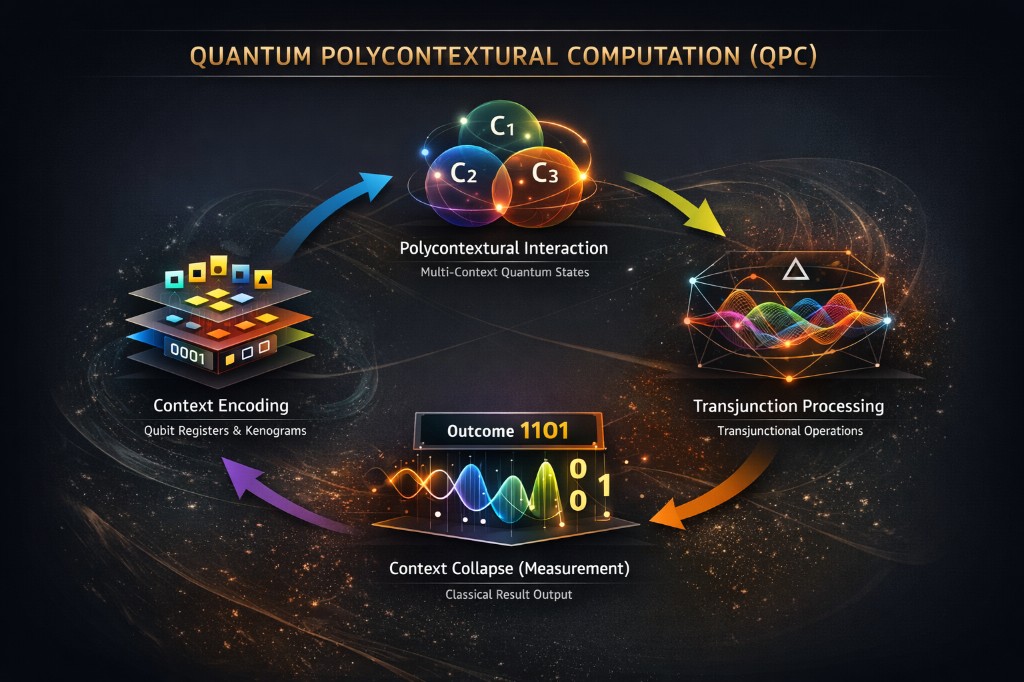
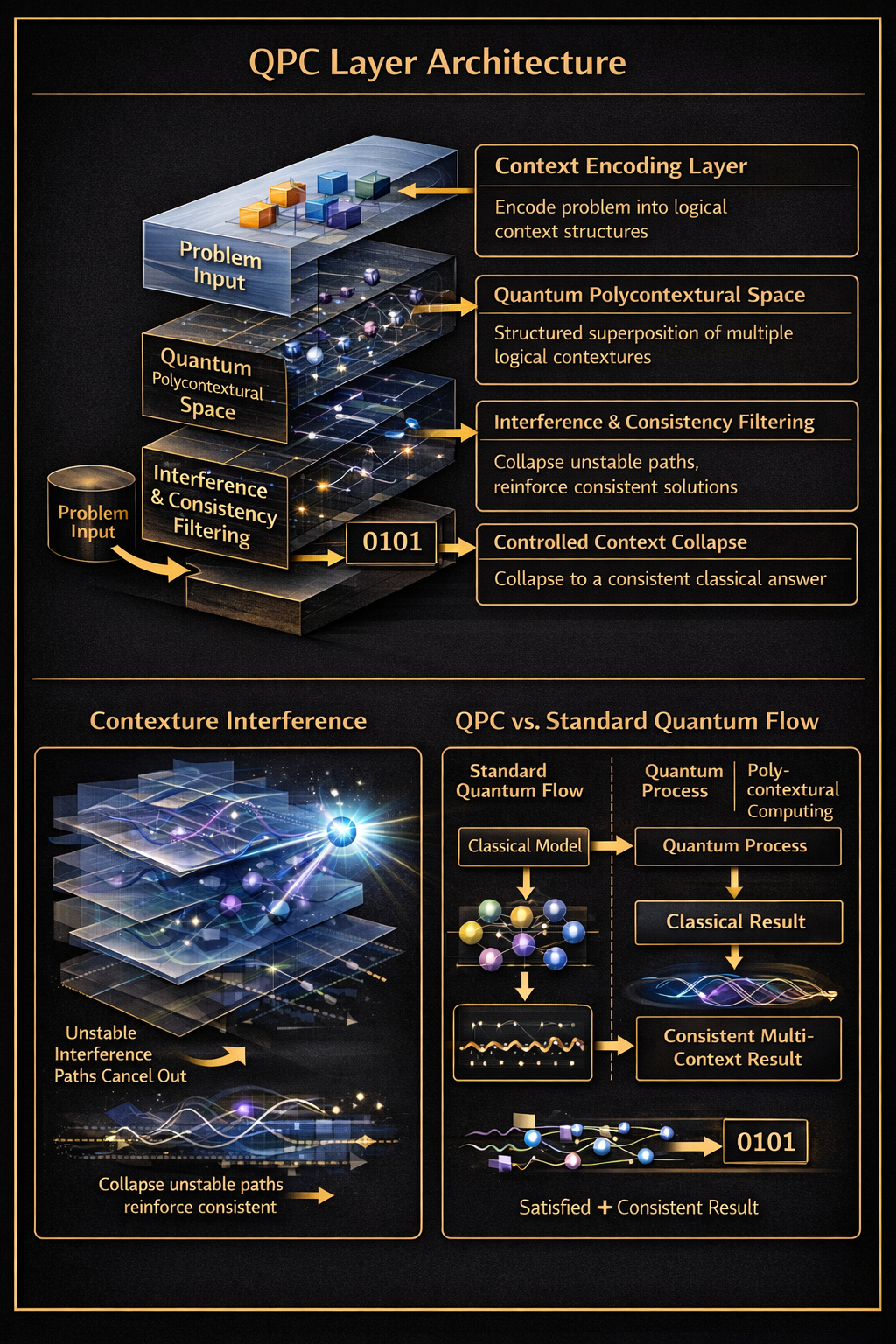
In Quantum Polycontextural Computing (QPC), the fundamental computational entity is not a binary bit or a single quantum state but a polycontextural configuration consisting of multiple interacting logical contextures. A QPC computational state can be described as a structured set Ψ = {C₁, C₂, C₃ … Cₙ} where each Cᵢ represents an independent logical contexture. Each contexture contains a configuration of quantum states and contextual relations that may coexist simultaneously with other contextures. Unlike classical systems, these contextures are not mutually exclusive. They may exist concurrently and interact through quantum operations.
Within each contexture, information is represented through kenogrammatic and morphogrammatic structures rather than Boolean truth assignments. These structures encode relational patterns between quantum states rather than fixed logical values. Thus computation operates on patterns of contextual relations, not on binary variables.
The fundamental transformation in QPC is the transjunctional operation. A transjunction transforms relationships between contextures rather than individual quantum amplitudes. Formally this can be described as a transformation T : Ψ → Ψ' where the mapping reorganizes contextual relations across the contextural network. These transformations allow: contextual interference; multi-layer logical interaction; structured coexistence of contradictory states.
The polycontextural structures are embedded into physical quantum systems through contextural encoding circuits. These circuits map contextures onto qubit registers while preserving contextual relations through entanglement and interference. Because QPC operates at the logical architecture layer, it can be executed on multiple quantum hardware platforms including: superconducting qubits, trapped ions, neutral atoms, photonic systems.
Observation of a QPC system produces a contextural collapse. During measurement, the polycontextural configuration Ψ collapses into a classical observable configuration: Ψ → Ω, where Ω represents the measurable classical output derived from the contextual superposition. The collapse does not eliminate contextual structure during computation; it only appears at the measurement boundary.
Because QPC allows simultaneous existence and interaction of multiple logical contextures, it enables representation of systems that are difficult or impossible to model within single-context computational frameworks. This includes: complex systemic interactions; multi-layer decision structures; context-dependent optimization problems; large-scale network cascade dynamics.
QPC Process: Context Encoding → Polycontextural Interaction → Transjunction Processing → Context Collapse (Measurement)
Yes — for problems that are classically hard or infeasible.
QPC execution: 5-7 seconds on IBM Quantum
Classical simulation: Would require ~590 exabytes of memory and years/centuries
Speedup: effectively infinite (classical cannot complete)
65 qubits, depth 8:
✅ QPC completes in ~7.6 seconds
❌ Classical: infeasible (petabytes, years)
Most current quantum algorithms operate within classical logical frameworks, even though the hardware is quantum.
This leads to decoherence, errors, and fundamental limitations that keep them decades from practical use.
Polycontextural Architecture is quantum at the logical level.
Quantum behavior emerges from multi-contextual logic itself. This is true quantum computing, production-ready today.
Simulate quantum systems on classical hardware
Run at room temperature but scale exponentially with qubit count
Useful for verification at small to mid sizes
Cannot faithfully emulate large deep quantum circuits at full scale
Strong for algorithm prototyping and baseline comparison
Quantum logic layer based on polycontextural structure
Executed today on real cryogenic QPUs (e.g., IBM) and other platforms
Performance currently limited by backend noise and compiled depth
Demonstrated hardware execution from small sizes up to 128 qubits
Roadmap: extend scale as hardware quality improves