1 September 2026 · Personal statement
QPC is on the stage. I am asking the quantum community to argue with it.
Quantum Polycontextural Computation now has a body of results large enough to be examined rather than described. More than thirty documented computations, every one executed on IBM quantum hardware, every one carrying a public job identifier that anyone with an IBM Quantum account can pull and read for themselves. The recognition question is settled for me. What I want now is argument.
Here is the position I claim, stated as precisely as I can put it.
Quantum hardware already produces its own answer in established places, and I count them. Physical systems are measured directly on the processor, where the measured quantity is the result: Google's out-of-time-order correlators on Willow, Quantinuum's superconducting pairing correlations on Helios. And certified randomness, where JPMorganChase and Quantinuum published bits generated on a 56-qubit trapped-ion processor in Nature in March 2025, with no classical optimiser anywhere in the workflow. That is a quantum-produced deliverable, and it is the cleanest one in the field.
IBM's Floquet dynamics work with Qedma on ibm_boston (Heron r3) is a different object: QESEM reconstructs a noiseless number after the chip has run. The unbiased guarantee stops where a classical check still exists; the novel-physics stretch is a heuristic extrapolation. That is estimation. I treat it as reconstruction, not as the computation returning its own result. The argument is written out here: Estimation versus computation.
Industrial decisions are the other case, and there the classical layer holds the answer. IBM describes its own quantum-centric chemistry workflow as offloading all but an intrinsically quantum component, with the molecular energy diagonalised on Fugaku from quantum-sampled configurations. The largest protein folding runs on trapped-ion hardware reach the reference optimum after a classical local search over the best quantum samples. The production deployments in manufacturing and logistics are hybrid solvers by design, and their vendors say so plainly.
QPC occupies a third position. The decision itself is the quantum computation, with several conflicting logics held co-resident and coupled inside one submitted circuit family, and the result read from the measurement counts. Transjunctions are computed on the QPU. The job readout is the reported answer. Where that third position has been occupied elsewhere, I would genuinely like to see it, and I am putting QPC forward to be argued with.
The line I am drawing here is the field's own, not mine. Callison and Chancellor stated it precisely in 2022: a workflow is hybrid when the classical computation appears in the abstract description of the algorithm. Error mitigation, readout correction, twirling and verification do not appear there, because they are corrections to a noisy device. A parameter optimiser, a problem decomposer, or a local search that turns a sampled candidate into the reported optimum does appear there, and it is doing the deciding.
A quantum physicist who opens QPC meets none of the instruments they were trained on: the familiar definitions, classical mathematics, the logical apparatus, one Hilbert space governed by one logic. In their place stand quantum logic, contextures, transjunctions, the empty structure of the quantum net, an architecture grid for computation. The reasonable first reaction is to ask where a critical evaluation would even begin. Making QPC legible is my work.
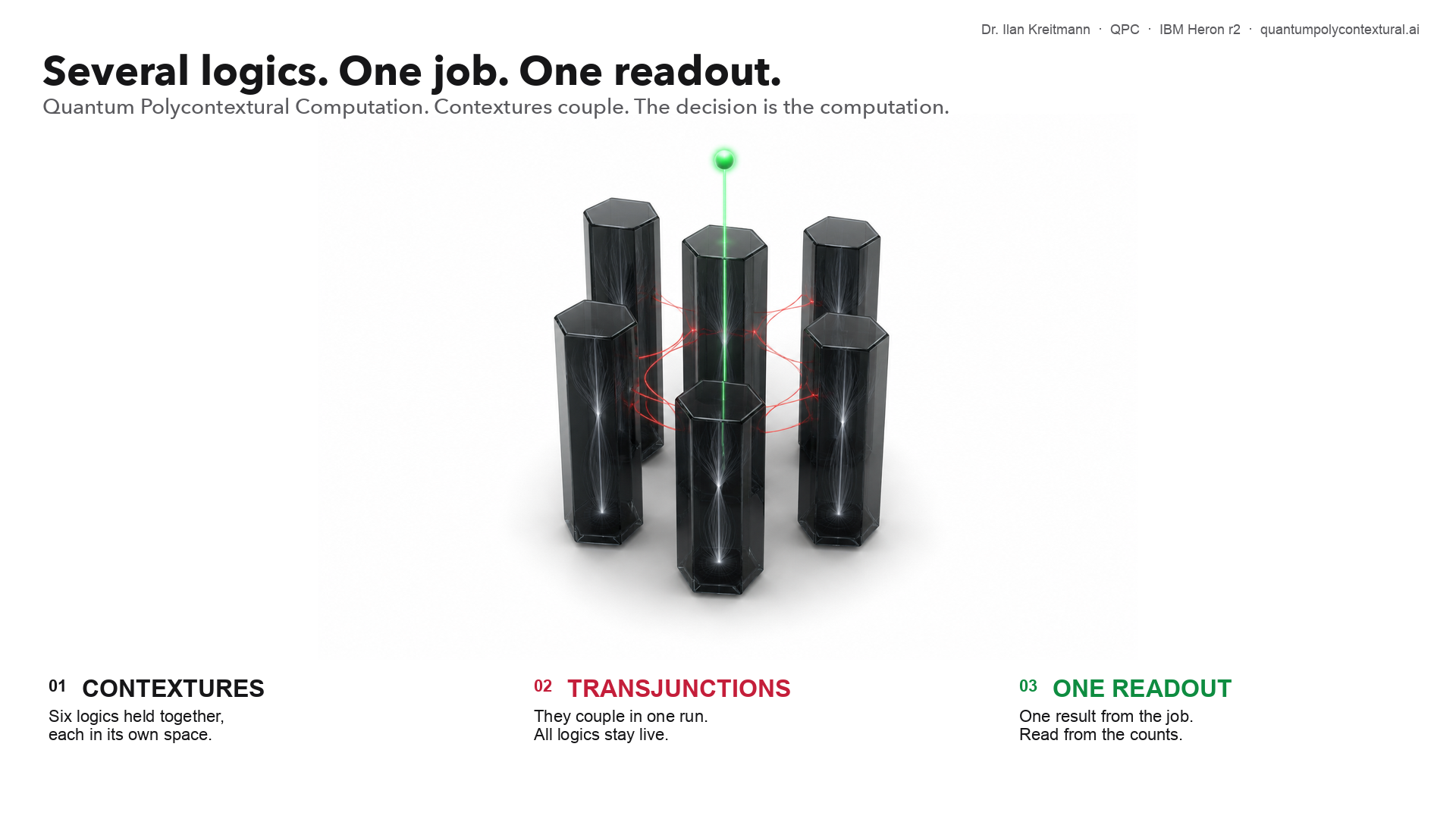
So, briefly. QPC rests on a quantum logic carrying many empty spaces in place of one, each space with its own logic. Empty here is kenogrammatic: structure held open, without predetermined valuation, rather than the vacuum of physics. Each space is a contexture. It holds qubits as kenograms and morphograms in superposition, as waves, entangled, and it serves as an architectural grid for computation. Contextures couple through transjunctions, and the whole runs as a single computation, parallel and simultaneous, resolved in one readout.
Why this belongs on a quantum processor is a matter of structure. A classical machine moving between contextures would have to read out the intermediate state at every step, and readout collapses the superposition that the next step requires. The computation exists while it stays uncollapsed. That is why it runs on quantum hardware and stays there.
Last week gives the clearest example I have. On the public ICCAD-2013 photomask benchmark we held six conflicting manufacturing criteria co-resident inside one job on a 156-qubit IBM Heron r2 processor: print fidelity, edge placement, process window across dose and focus, mask width legality, mask space legality, and writer cost. Standard practice adds these into a single weighted score and descends. On our frozen panel, weighting all six equally produces the exact reverse of the ranking produced by the published print-only objective, so the weighting fixed in advance decides the answer. Held together instead, the computation returned no-OPC 0.622 over the published ILT mask 0.460. Everything is public: the hash-locked input panel, the pre-registration, the job identifier daas1burrl7c73860bd0, and a readability gate that requires the decision margin to exceed the chip's measured deviation.
That last detail matters to me more than the result does. Architecture claims are scored on raw counts, and a run counts only when the machine can resolve it.
Four questions, then. I would value a position on any of them, for or against.
- Where has a real-world industrial decision been delivered as the readout of a quantum computation, with no classical optimiser, solver or solution-repair step producing the reported answer?
- When several engineering criteria genuinely conflict, what justifies fixing their weights before the computation instead of letting the computation settle them?
- Is there a reason in principle why a classical machine could carry a polycontextural computation without collapsing it at each step?
- We score architecture claims on raw counts, under a threshold requiring the decision margin to exceed the chip's measured deviation. What would you require instead?
The computations ran on real quantum hardware and the jobs are open for inspection. Sample highlights are published here:
Highlights: quantumpolycontextural.ai/qpc_highlights_report.html
Pharma Atlas: quantumpolycontextural.ai/QPC_PHARMA_ATLAS.html
Real-World Desks: quantumpolycontextural.ai/qpc_real_world_desks.html
Estimation versus computation: quantumpolycontextural.ai/QPC_ESTIMATION_VS_PROOF_ARTICLE.html
Read the jobs. Open the pages. Then tell me where you stand.
It is time for QPC to take its place on the quantum computation stage as a working instrument. It is there now, it is running, and it is open.
Dr. Ilan Kreitmann
Quantum Polycontextural Computing